

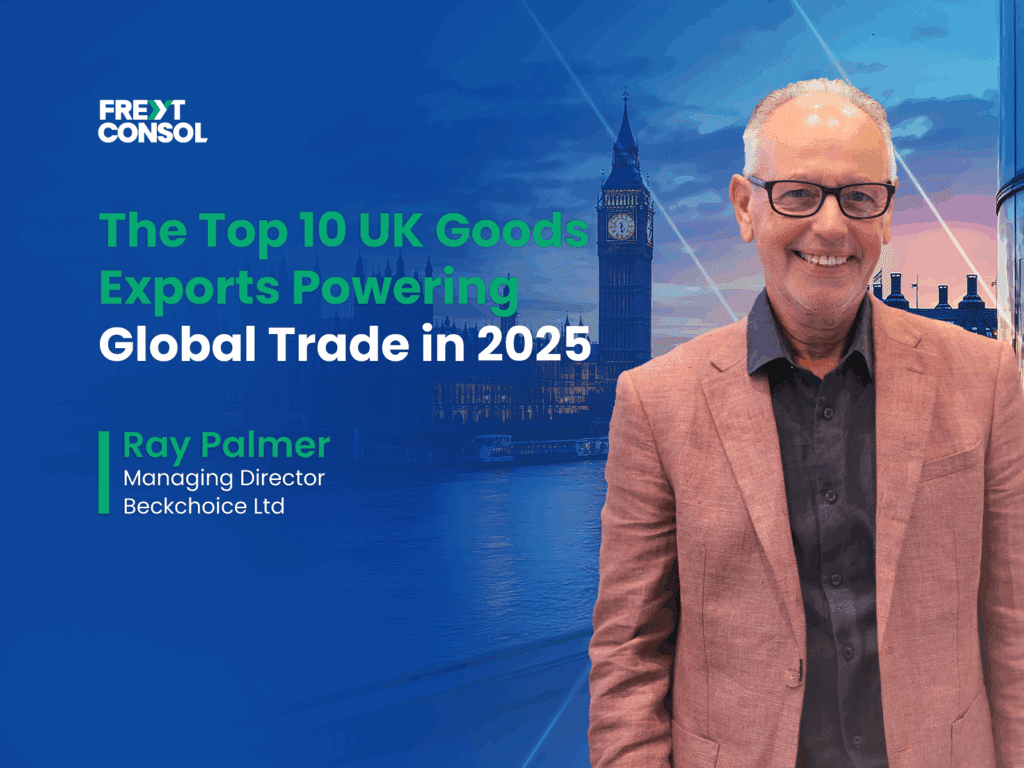
By Ray Palmer, Managing Director at Beckchoice Ltd
The global economy is a complex, ever-shifting engine, and in late 2025, the United Kingdom remains one of its most vital components. Despite the economic headwinds of the decade and shifting geopolitical alliances, British industry has demonstrated remarkable resilience and growth.
The latest government data, covering the 12 months to the end of September 2025, reveals a robust performance: the United Kingdom’s total trade value has climbed to £1,882.4 billion. This figure represents more than just currency exchanged; it is the culmination of millions of hours of engineering, research, manufacturing, and, crucially, logistical coordination.
At Freyt Consol, we understand that behind every billion-pound statistic lies a web of supply chains, freight forwarders, and customs experts ensuring that goods move seamlessly from factory floor to final destination. To better understand what is powering this growth, we turned to one of our esteemed members, Beckchoice, for a deep dive into the data.
Ray Palmer, of Beckchoice, notes the diversity of the current market: “When you look at the top ten exports for 2025, you aren't just seeing raw materials. You are seeing high-value, high-complexity engineering alongside critical energy resources and luxury goods. From aircraft engines to scientific instruments, the UK isn't just shipping boxes; we are exporting innovation.”
In this article, we analyze the Top 10 UK goods exports for 2025, explore the specific logistical challenges associated with each sector, and discuss how expert forwarders are bridging the gap between British manufacturers and the world.
1. Mechanical Power Generators (Intermediate)
Export Value: £43.8 Billion
Topping the list with an impressive £43.8 billion in export value are Mechanical Power Generators. This category acts as the heartbeat of industrialization worldwide, supplying the energy infrastructure for developing nations and upgrading the grids of established economies.
The Industrial Heavyweights
This sector includes a vast array of machinery, including turbojets, gas turbines, and internal combustion engines. These "intermediate" goods are often shipped to other countries to be integrated into larger systems, such as power plants, marine vessels, or massive industrial factories.
Logistical Insight: Project Cargo and Out-of-Gauge (OOG)
Shipping mechanical power generators is rarely a standard "box-shifting" exercise. These items are frequently heavy, oversized, and high-value, often classified as "Out of Gauge" (OOG).
“With power generation equipment, the planning phase is just as critical as the transit itself,” says Palmer. “We are looking at route surveys to ensure bridges can hold the weight of the haulage trucks, arranging flat-rack containers for sea freight, and coordinating specialized lashing to secure the cargo against rough seas. One miscalculation in the center of gravity can be catastrophic.”
2. Medicinal and Pharmaceutical Products
Export Value: £39.9 Billion
In second place, with an export value of £39.9 billion, is the Medicinal and Pharmaceutical sector. The UK remains a global superpower in life sciences, home to some of the world's largest pharmaceutical companies and cutting-edge biotech research facilities.
The Life-Saving Supply Chain
This category ranges from bulk chemical compounds to finished vaccines, antibiotics, and specialized treatments for rare diseases. The demand is global, driven by the high regulatory standards of the MHRA, which assures international buyers of safety.
Logistical Insight: The Integrity of the Cold Chain
Pharmaceutical logistics is a battle against time and temperature. A deviation of a few degrees can render a shipment worth millions worthless.
“In the pharma sector, we aren't just moving freight; we are protecting patient health,” Palmer emphasizes. “This requires strict adherence to Good Distribution Practice (GDP). We utilize temperature-controlled containers, data loggers that track the environment in real-time, and expedited air freight solutions for urgent medicines.”
3. Cars
Export Value: £31.6 Billion
The automotive industry remains a jewel in the UK’s export crown, contributing £31.6 billion to the economy. Despite global supply chain fluctuations, British automotive manufacturing retains a prestigious reputation, particularly in the luxury and high-performance sectors.
Logistical Insight: Hazardous Goods and Battery Regulations
The rise of EVs has introduced a new layer of complexity: Lithium-Ion batteries, classified as Dangerous Goods (DG).
“Shipping internal combustion cars is a well-trodden path,” Palmer notes. “But with EVs, we have to be hyper-aware of the IMDG codes. The risk of thermal runaway means carriers are incredibly strict about how these vehicles are declared and stowed. For high-value luxury vehicles, we often utilize containerized shipping with specialized racking systems.”
4. Non-Ferrous Metals
Export Value: £13.0 Billion
Coming in fourth are Non-ferrous Metals, with an export value of £13.0 billion. This category includes aluminum, copper, lead, zinc, tin, and precious metals—materials that do not rust and are essential for electronics and aerospace.
Logistical Insight: Density and Market Volatility
The logistics of metals are driven by commodity markets and physical density.
“The challenge with non-ferrous metals is that they are incredibly dense,” explains Palmer. “You will hit the weight limit of a standard 20ft container long before you fill the space. Furthermore, metal prices fluctuate daily. Speed is currency in the commodities game; our clients need us to secure space on vessels at short notice to capitalize on market spikes.”
5. Aircraft
Export Value: £12.5 Billion
Rounding out the top five is the Aircraft sector, generating £12.5 billion. The UK is the second-largest aerospace manufacturer in the world, specializing in high-tech components like wings, engines, and avionics.
Logistical Insight: AOG and Extreme Fragility
Aerospace logistics often operates under "Aircraft on Ground" (AOG) conditions. When a plane breaks down, it costs the airline huge sums every hour.
“Aerospace requires a 'white glove' service on an industrial scale,” says Palmer. “We are dealing with components that are massive yet fragile. They require custom-built cradles, air-ride trucks, and tarmac-level supervision. When an AOG situation hits, we move parts via 'Next Flight Out' services.”
Export Value: £12.3 Billion
6. Crude Oil
Entering the chart at number six is Crude Oil, with £12.3 billion in exports. Despite the global push for green energy, the UK’s North Sea reserves remain a critical asset for the energy market.
Logistical Insight: Liquid Bulk and Safety
Transporting crude oil is a highly specialized field dominated by liquid bulk logistics.
“This isn't typical containerized freight,” Palmer explains. “It involves coordinating pipelines to terminals and chartering massive tanker vessels. The safety protocols are paramount due to the environmental and fire risks. Documentation here is heavy, Bills of Lading must be precise to the barrel, and insurance cover is complex.”
7. Scientific Instruments (Capital)
Export Value: £12.1 Billion
Reflecting the UK's status as a hub for research and development, Scientific Instruments generated £12.1 billion. This includes lasers, medical scanners, and precision measuring equipment.
Logistical Insight: Shock Sensitivity and Calibration
Unlike robust industrial machinery, scientific instruments are often hyper-sensitive to shock and vibration.
“You cannot simply forklift a high-end spectrometer,” warns Palmer. “These units often contain delicate optics or calibrated sensors that can be misaligned by a pothole. We use shock-watch indicators, simple stickers that turn red if the crate is dropped and air-suspension vehicles to ensure the equipment arrives in lab-ready condition.”
8. Beverages and Tobacco
Export Value: £11.8 Billion
A staple of British culture, the export of Scotch Whisky, gin, and tobacco products brought in £11.8 billion. Scotch Whisky alone accounts for a massive percentage of UK food and drink exports.
Logistical Insight: Excise Duty and Security
The primary challenges here are theft prevention and tax compliance.
“High-value alcohol is a target for theft,” says Palmer. “We often use hard-sided containers and high-security seals. Additionally, the paperwork is intense due to excise duties. If you don't have your T1 transit forms or EMCS (Excise Movement and Control System) declarations correct, the shipment will be seized at the border. For wine exports, we also look at thermal liners to prevent spoilage during transit through hot climates.”
9. Miscellaneous Electrical Goods (Intermediate)
Export Value: £10.0 Billion
At number nine, with £10.0 billion, are Miscellaneous Electrical Goods. This broad category covers everything from circuit boards and semiconductors to industrial switches and cabling.
Logistical Insight: Speed and WEEE Regulations
This sector feeds into "Just-in-Time" manufacturing lines globally. A delay in a shipment of capacitors can halt a production line in Germany or China.
“Speed is vital here,” Palmer notes. “But so is compliance with WEEE (Waste Electrical and Electronic Equipment) and RoHS (Restriction of Hazardous Substances) regulations. Exporters need to prove that their components don't contain banned substances like lead or mercury above the threshold, or the goods will be rejected by customs.”
10. General Industrial Machinery (Capital)
Export Value: £9.9 Billion
Completing the top ten is General Industrial Machinery with £9.9 billion. This includes factory robots, packaging machines, and construction equipment.
Logistical Insight: Disassembly and Reassembly
Often, these machines are too large to ship whole.
“We frequently manage the logistics of 'knock-down' machinery,” explains Palmer. “A machine is dismantled into five or six containers. The logistical challenge is ensuring that Container A and Container B arrive at the destination at the same time so the engineers can begin reassembly immediately. Coordination is everything.”
Navigating the Complexities of Global Trade
Looking at these Top 10 exports, a pattern emerges. The United Kingdom produces goods that are heavy, sensitive, regulated, or high-value.
You cannot simply put a gas turbine in the post. You cannot ship a vaccine without a temperature audit trail. You cannot export whisky without navigating excise duties.
This is where the "total trade value of £1,882.4 billion" faces its biggest bottleneck: Process.
In the post-Brexit landscape, the administrative burden on exporters has increased. Customs declarations, rules of origin, safety and security declarations, and VAT accounting have become hurdles that can stall growth. For a business trying to scale its exports, navigating this red tape can be as difficult as manufacturing the product itself.
The Freyt Consol network is built on the premise that local expertise is the key to global success. Members like Beckchoice provide that local knowledge, ensuring that UK exporters can navigate these hurdles with confidence.
The Beckchoice Advantage
At Beckchoice, the philosophy is simple: logistics should be an enabler of growth, not a barrier.
As highlighted in their recent update, their in-house Exports team is designed to support customers at every stage of the journey. They don't just book space on a ship; they act as an extension of the client's business.
“We have been managing land, sea, and air freight since 1979,” Palmer reflects. “We have seen the industry change from telex machines to blockchain, but the core principle remains the same: relationships. Whether we are coordinating a shipment of mechanical generators or arranging clearances for pharmaceutical products, we are keeping goods moving worldwide with ease and compliance.”
Beckchoice supports the diverse needs of the UK’s top export sectors through:
- Comprehensive Customs Clearance: Handling the paperwork to ensure goods, whether non-ferrous metals or luxury cars, clear customs smoothly.
- Specialized Project Cargo: Offering heavy-haulage transport, crane hire, and charter vessels for goods that defy standard dimensions.
- A Personal Touch: In an industry increasingly dominated by automation, Beckchoice prides itself on human connection. “When you are shipping millions of pounds worth of inventory, you want to speak to an expert, not a chatbot,” says Palmer.
Conclusion
The data is clear: British products are in high demand. The potential for growth in late 2025 and beyond is immense for businesses that have the right product and the right logistics strategy.
Whether you are an established exporter contributing to these multi-billion pound statistics, or a growing business looking to send your first shipment abroad, the complexity of the process should not hold you back.
Beckchoice stands ready to help businesses grow their exports and streamline existing processes. For those looking to navigate the complexities of the UK market, the team is just a call away.
If your business is looking to grow its exports, get in touch with Beckchoice's Export Manager, Laura, to discuss how they can help.

Article written by
Freyt Consol is a global network for LCL consolidators and NVOCCs dedicated to excellence and long-term growth. We create an environment where members thrive by collaborating with trusted partners and accessing essential resources.
Read more Freyt Consol Blogs ⇲
- Sri Lanka as the Premier Hub for South Asian LCL
 Sri Lanka has cemented its position as the premier hub for South Asian LCL consolidation, with Colombo at the center of regional connectivity. Record container volumes, expanded terminal capacity, and full digital customs integration are strengthening its role as a relay gateway for the Indian Subcontinent. For forwarders moving East–West cargo, Colombo now offers the frequency, speed, and precision LCL operations demand.
 - Optimizing Global Trade via Indonesia Logistics Excellence
 Indonesia’s complex logistics landscape is being transformed through local expertise, LCL consolidation, and digital innovation. Featuring insights from Halim of PT. Bintang Samudra Indonusa (BS LINE), it shows how Freyt Consol partners help global businesses navigate Jakarta’s gateways, archipelago challenges, and evolving trade frameworks with confidence.
 - How Tanzania is Transforming Logistics
 Tanzania’s rise as a key logistics hub for East and Central Africa, driven by port modernization, rail infrastructure, and digitalization. Featuring insights from Rambabu Gurram of Allcargo Tanzania Limited, it highlights how local expertise and LCL consolidation are helping global businesses unlock the region’s growing trade potential.