

21 Feb 2025
India’s Maritime Expansion: $3 Billion Investment Reshapes Global Shipping Industry
By Srimani Kandan, Co-Founder & Director of Saccon Lines India Pvt Ltd.
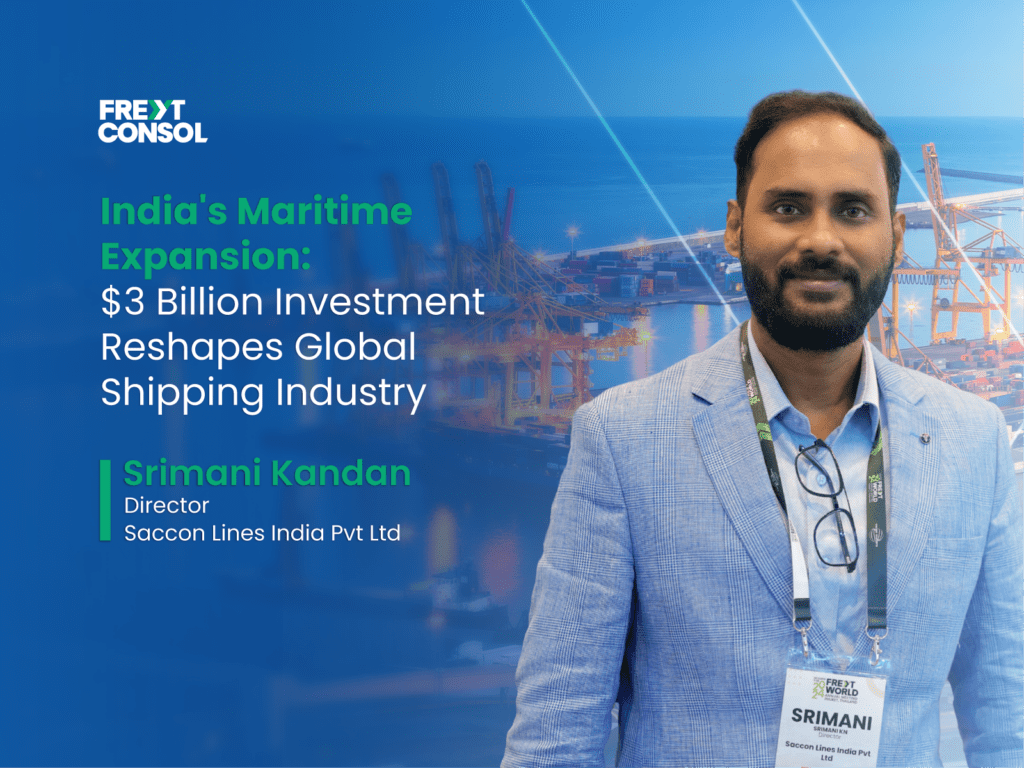
India's logistics market has reached a significant milestone, currently valued at USD 427.73 billion in 2024. With projections indicating a CAGR of 6.5% through 2034, the market is expected to reach USD 756.72 billion, marking a new chapter in India's maritime expansion.
How India's Maritime Expansion is Transforming Global Trade
At the heart of this transformation is the launch of Bharat Container Line, a state-backed initiative that promises to reshape the nation's role in global trade. The venture's ambitious scope includes an initial fleet of 100 vessels operating on key trade routes, representing a significant leap from the current Shipping Corporation of India's modest fleet of four container ships.
Supporting India's maritime expansion is a comprehensive $3 billion Maritime Development Fund, designed to bolster domestic shipbuilding initiatives, enhance port infrastructure, and finance overseas infrastructure projects. The government has outlined several transformative projects, including a new major port at Vadhavan, Maharashtra, with an investment of ₹76,220 crores or approximately USD 9.1 billion.
Strategic International Partnerships Driving Maritime Growth
India's maritime strategy extends beyond national borders, fostering international cooperation through strategic partnerships. A notable example is the collaboration with France's CMA CGM and the development of the India-Middle East-Europe Economic Corridor (IMEC).
Environmental sustainability forms a crucial component of India's maritime vision. The sector is embracing green initiatives with targets including 60% renewable energy usage at major ports by 2030. Additionally, the implementation of shore power supply is a key goal. Furthermore, the adoption of multi-clean fuel systems is being prioritized. Consequently, these efforts aim to significantly reduce the environmental impact of maritime operations.
Economic Impact of India's maritime expansion
The economic implications of India's maritime expansion are substantial. Current logistics costs, which account for 13-14% of India's GDP, are targeted to reduce to 7.5% by 2028. The sector currently handles 4.6 billion tonnes of goods annually and provides employment to 22 million people.
Major ports have already shown significant improvements, with container turnaround time reduced to 22.57 hours, exceeding global benchmarks. The government's updated Shipbuilding Financial Assistance Policy has provided ₹337 crore (USD 40.40 million) in financial aid, resulting in 313 vessel orders worth ₹10,500 crore (USD 1.26 billion).
Future Outlook: India's Position in Global Maritime Trade
India's comprehensive maritime expansion represents a strategic move to establish itself as a major player in global shipping. Through carefully planned investments, international partnerships, and sustainable practices, the nation is positioning itself to influence future maritime trade patterns. Additionally, these efforts support its domestic economic growth, ensuring a balanced approach to both international and local development. Consequently, the nation can achieve significant progress in the maritime sector.

Freyt Consol Blog Contributor
Freyt Consol is a global network for LCL consolidators and NVOCCs dedicated to excellence and long-term growth. We create an environment where members thrive by collaborating with trusted partners and accessing essential resources.
Read more Freyt Consol Blogs ⇲
- India Logistics Outlook 2026 for Freight Forwarders
 India’s logistics sector is entering a transformative phase in 2026, with Mumbai positioned at the center of LCL consolidation growth. Driven by digital customs reforms, infrastructure expansion, and government-backed initiatives, exporters are gaining greater efficiency and predictability. Gaurav of AMI Global Logistics shares how forwarders can leverage system connectivity, multimodal hubs, and strategic consolidation to stay competitive in the evolving Indian trade landscape.
 - Kuwait Logistics Hub for Global Trade Success
 Kuwait’s growth as a logistics hub under Vision 2035, focusing on LCL demand and infrastructure. It highlights expert insights on digitalization, cold chain logistics, and regional trade opportunities.
 - Strengthening Global Trade through Chennai’s LCL Hub
 Chennai is emerging as a premier hub for LCL consolidation, driving India’s export growth through advanced infrastructure and digital innovation. With strategic reforms, multimodal connectivity, and sustainability initiatives, the city is redefining efficiency in global logistics. Srimani of Saccon Lines India Pvt Ltd shares expert insights on how Chennai’s capabilities are enabling seamless trade and supporting the evolving needs of international freight forwarders.